How it reads
One source, read often, and labelled every time.
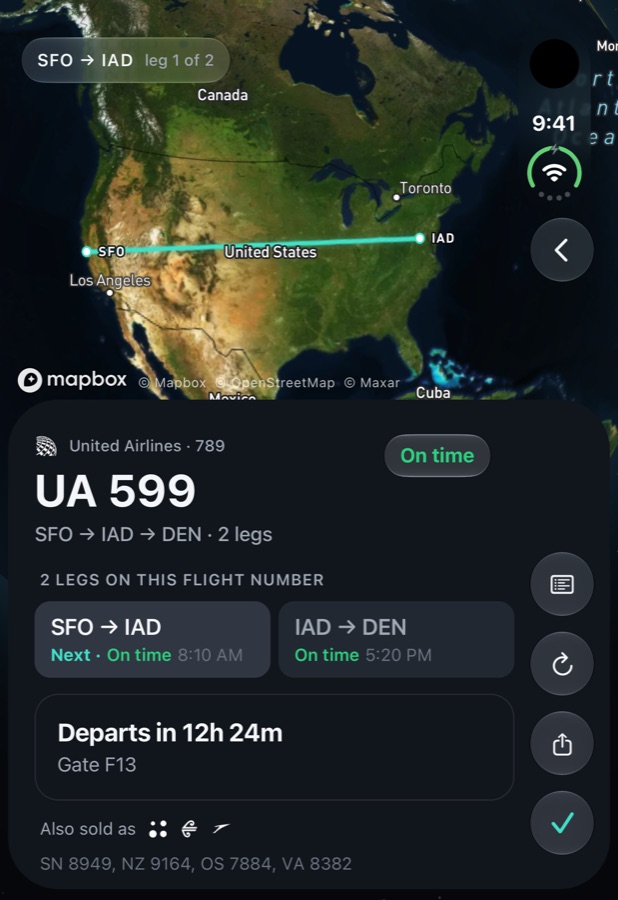
Blip has one flight-data source: the flight library Exa publishes. Each flight, airport board and route search is one page there. Blip reads the page, turns it into a typed model, and keeps two things attached to every model: a list of what the page did not contain, and a record of where and when it was read.
What is read
- A flight number on a date. Every leg it flies that day, with scheduled, estimated and actual times on each airport's clock, terminals, gates, baggage belt, aircraft type and codeshares.
- An airport board. Departures or arrivals for a date, in windows of the day. The page states how many flights exist in the window; a busy hub lists the first 100 of them.
- A route. Nonstop and connecting options between two airports or cities, with the lowest one-way economy fare on nonstops. Fares move between reads, so the app shows a fare as current for ten minutes and then stops.
When it is read
Every read asks Exa for a fresh render rather than a stored copy. The time printed beside the data is the moment that read came back, not the moment the page you are looking at was drawn. On this site a flight page is reused for up to a minute and a board for two, so many visitors share a read. Exa itself does not refresh faster than once a minute.
A flight that has arrived and published its baggage belt, or was cancelled, is final. It is kept for an hour instead of a minute, and it still shows the minute it was read.
What is computed
Some things in the app are not on any single page: an airport's on-time share, a connection's risk, a leave-by time, the change between two reads. Each is computed from pages that were read, and each one shows the sentence that says what it was computed from. Route progress comes from the clock alone and is labelled as an estimate.
Distances are great-circle kilometres between the two airports' coordinates, from a table of 6,438 airports shipped with the app.
What the source does not publish
- Aircraft position. There is no live track. Blip draws routes, never a plane on a map.
- Seat maps. None.
- Reasons for delays and cancellations. Not seen on any page read so far. The app says the reason was not published.
- Gates and belts, sometimes. Many airports publish them late or not at all. Where a page has none, the screen says so in words. A dash would read as zero.
- Dates beyond twelve months. They come back as not found. Exa gives the same answer for a wrong code, a route with no flights and a filter that matched nothing, so Blip lists all four causes rather than guessing one.
This deployment
Read through the Blip relay, which holds the Exa key and reads each page once for every viewer, on the app's own schedule.
The night Earth on the globe is NASA's Black Marble composite, which is public domain. Airline marks are each carrier's own artwork. Where no usable mark exists, the two-letter code stands in, never a coloured letter made up for the purpose.